
On this page 5 sections
Choosing an implant system is really five smaller decisions, and getting the order right matters more than most of the individual choices. Pick the connection platform last and a case can end up with an implant that fits the site but not the restorative parts already on the shelf. Pick it first, and every choice after it narrows on its own. This page runs through that order using the ten series in the i-Fix range: SP, S-Fix Pro, IP, IP+, AK, AK*, B, C, ZE and PSI. For the full specification of any one series, its thread geometry, surface treatment and complete size matrix, the companion piece on this site, linked at the end, goes deeper than a decision guide needs to.
Start with the connection platform, not the series name
A connection platform decides which restorative components (abutments, healing caps, impression copings, analogs, scan bodies) an implant will take for the rest of its life, which is why it comes before anything else. i-Fix runs two named platforms. NP is a conical connection with a 2.25 mm A/F internal hex, a 12° Morse taper and an M1.6 screw, and it covers the IP and AK Series. RP is a 2.50 mm A/F internal hex, an 11° Morse taper and an M2.0 screw, and it covers the SP Series (also sold as S-Fix Pro) and the announced AK* Series. AK* carries the AK name but sits on RP, not on AK's own NP platform, so the name alone is not a reliable guide to the connection. IP+ is announced on its own IP connection (2.45 mm A/F, 45° Morse taper, M1.8 screw) and does not share components with either NP or RP. The B and C Series are one-piece implants with no separate abutment connection at all, and ZE is a zygomatic system on an M1.6 internal connection with an external hex of 2.25 mm A/F, restored through multi-unit abutments rather than a single-tooth connection.
Decide one-piece or two-piece
A two-piece implant (SP, IP, AK, ZE and the announced IP+ and AK*) places the implant body first and connects a separate abutment afterward, which is what makes a connection platform relevant at all. A one-piece implant has no second component: the prosthetic segment is part of the same body that goes into bone. i-Fix publishes two one-piece lines. The B Series has a polished surface and a bendable prosthetic segment, and its catalog indications name full-mouth rehabilitation, thin-ridge anatomy, cases aiming to avoid bone grafting, and placement directly in extraction sockets. The polished surface is specified for protection from bacteria where an implant goes into an infected socket. The C Series is a one-piece compressive design, with surface-treated threads and catalog indications naming narrow ridges needing minimal osteotomy, immediate-loading protocols, and condensation of soft cancellous bone. Choosing one-piece removes a step from the surgical and restorative sequence. Choosing two-piece keeps the option to change the abutment angulation or emergence profile after placement.
Match the thread and body design to the bone in front of you
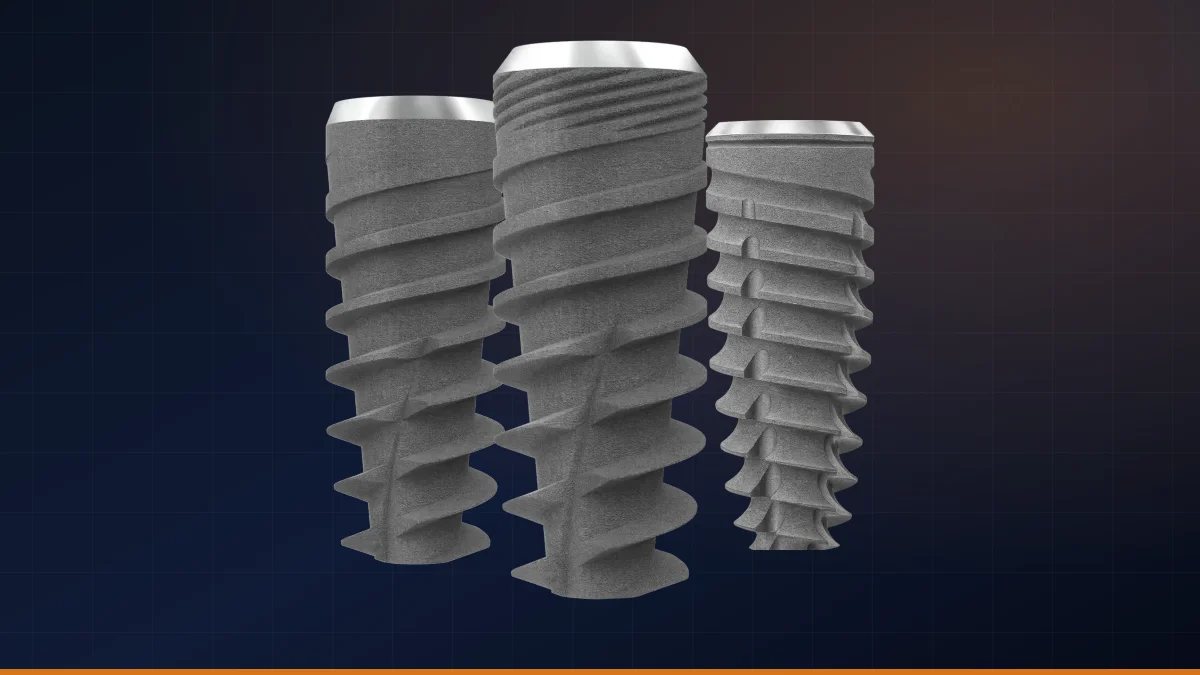
Once the platform and piece count are settled, the body geometry is what the catalog actually differentiates on. SP and IP share the same expanding-taper, two-start thread design with a backtapered coronal region and twin apical cutting blades. The catalog specifies this design as attaining high stability even in compromised bone, with IP running the longer, larger-diameter end of that family. AK and the announced AK* carry a different geometry, a progressive high-angle thread with varying thread depth, a concave apex and multiple cutting flutes, which the catalog specifies as particularly beneficial in low-density bone and immediate-placement protocols. The C Series' compressive threads are specified for soft cancellous bone through a minimal osteotomy. ZE is the outlier by intent: a graftless zygomatic system, 30 to 62.5 mm in length with a 55° angulated head, anchored in the zygomatic bone itself rather than the alveolar ridge, for an atrophic or graft-deficient maxilla where the catalog indications specifically name avoiding bone-grafting procedures and an immediate fixed provisional through multicortical anchorage.
| Series | Connection | Piece count | Catalog indications / design intent |
|---|---|---|---|
| SP Series (S-Fix Pro) | RP | Two-piece | Expanding-taper thread, specified for high stability including compromised bone |
| IP Series (i-Fix Pro) | NP | Two-piece | Same expanding-taper family as SP, longer and larger-diameter range |
| AK Series (Apex Konnect) | NP | Two-piece | Progressive HA thread, specified for low-density bone, immediate placement |
| AK* Series | RP | Two-piece | Same progressive HA thread as AK, on the RP platform. Coming soon |
| IP+ Series | IP (its own) | Two-piece | Same body family as IP on a dedicated connection. Coming soon |
| B Series (i-Fix One) | One-piece | One-piece | Bicortical, bendable, polished surface. Thin ridge, extraction socket, avoiding grafting |
| C Series (i-Fix C-1) | One-piece | One-piece | Compressive threads. Narrow ridge, soft cancellous bone, minimal osteotomy |
| ZE Series (i-Fix Zygon) | External hex, multi-unit restored | Two-piece | Zygomatic anchorage — atrophic maxilla, graftless, immediate fixed provisional |
| PSI Series | Case-specific | Case-specific | Digitally designed per patient from CBCT and scan data rather than a fixed catalog size |
The PSI Series sits outside that matrix by design: rather than choosing between fixed diameters and lengths, a case goes through CBCT-based case planning, anatomy-led digital design and mandatory virtual biomechanical validation before an implant is machined to that patient's own bone volume and density. It is the route for a case the standard size range does not cover, not a substitute for it.
Check the prosthetic support is already on hand
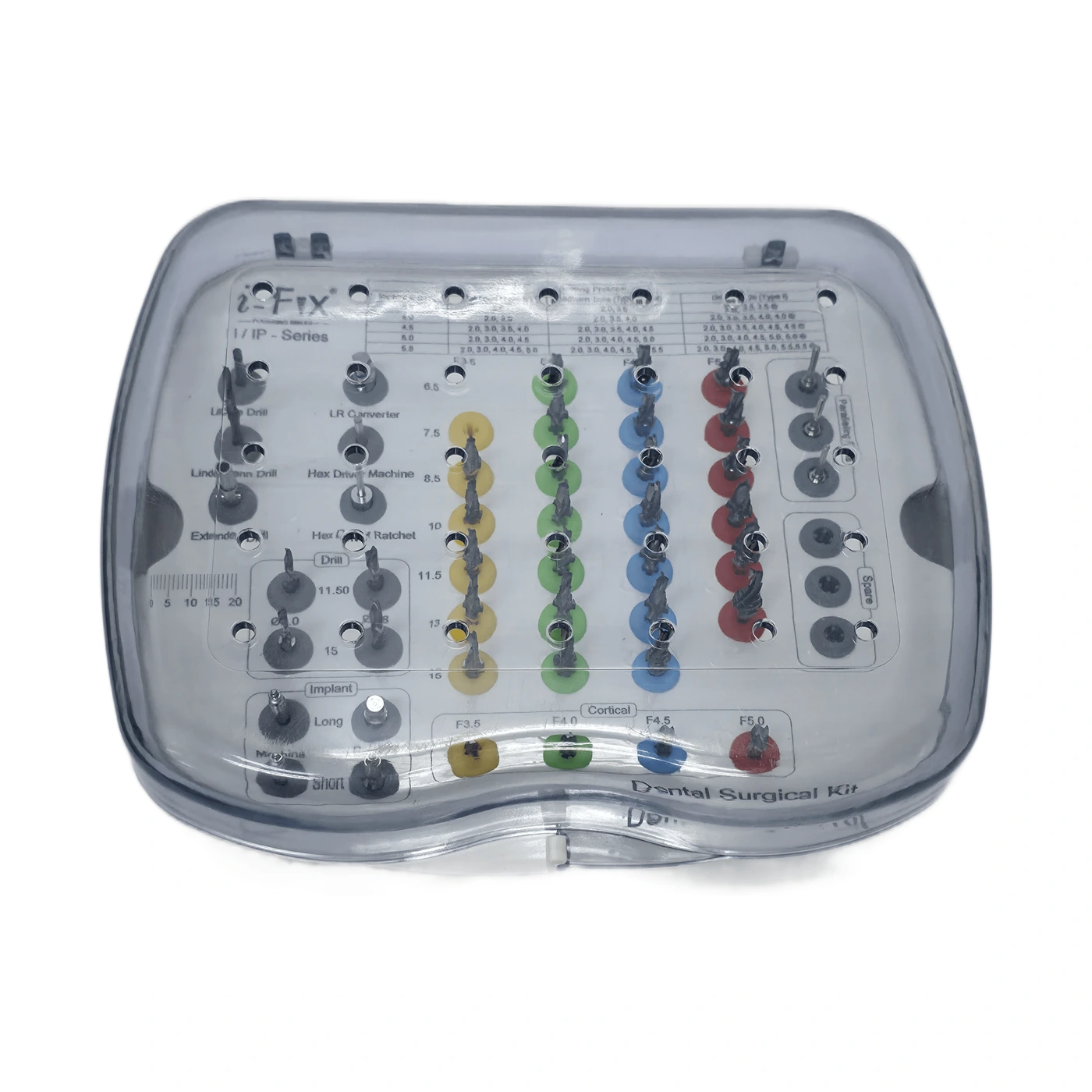
Once the platform is fixed, the restorative component set follows it rather than the series name. One NP set covers every NP implant, one RP set covers every RP implant, and ZE runs on its own multi-unit set. A practice or lab moving to digital workflows should also confirm the scan body and Ti base exist for that same connection before the case is scheduled, since a digital impression on the wrong part number stops the case at the laboratory rather than in the mouth.
Confirm the documentation before the first order
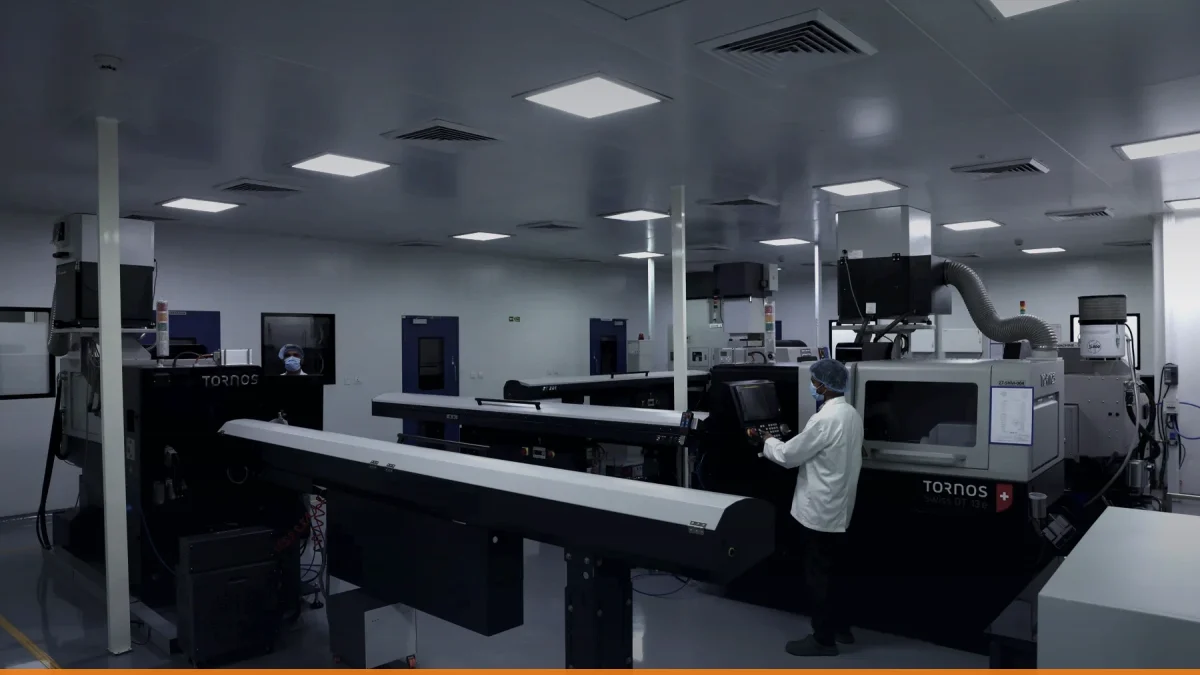
The last check is paperwork, and it takes minutes against an order that will run for years. Every released series has its own Instructions for Use and its own or a shared catalog listing the full size matrix and article codes. The SP, IP, AK and ZE Series each publish a size matrix with real article codes. IP+ has none published yet, because the series is not released. AK* publishes real article codes across three diameters and three lengths ahead of general availability. Manufacturing runs under EN ISO 13485:2016 (certificate no. QMS-13-013-2021/C, valid to 1 September 2027) and a second ISO 13485:2016 certification under NABCB accreditation (valid to 26 July 2028), and the implants carry CE marking under EC Certificate no. 1434-MDD-344/2021, carried forward under the EU MDR 2023/607 transition provisions. The IFUs, the catalogs and the certificates themselves are all viewable on the Downloads page linked below, each by its own certificate number.